Any advice for students considering a career in science?

You should prepare yourself as best as possible. Science is as fascinating as it is challenging and hard work. Only people with a great capacity of work and resilience are capable of making a career in science. Prepare well and join the best institutions that can give you the right conditions to succeed.

Work, happiness, and success do not come alone. Science is teamwork and only the best teams win. INL has excellent conditions for doing science in Portugal, at the level of the best institutions in the world.


If you weren’t a Researcher, what would you be doing?

I’m especially touched by engineering challenges. I’m the happiest person putting my hands on the job and making it happen, I am more action than words. If I had to choose a different career, I think it would be in the field of architecture or landscape architecture. Not because I’m a good designer or a particularly creative person, but because I like to see things get out of my hands, to make them happen and see their impact on society and people’s lives.

Thinking about taking your career to the next level? Join INL as a MSCA Fellow!
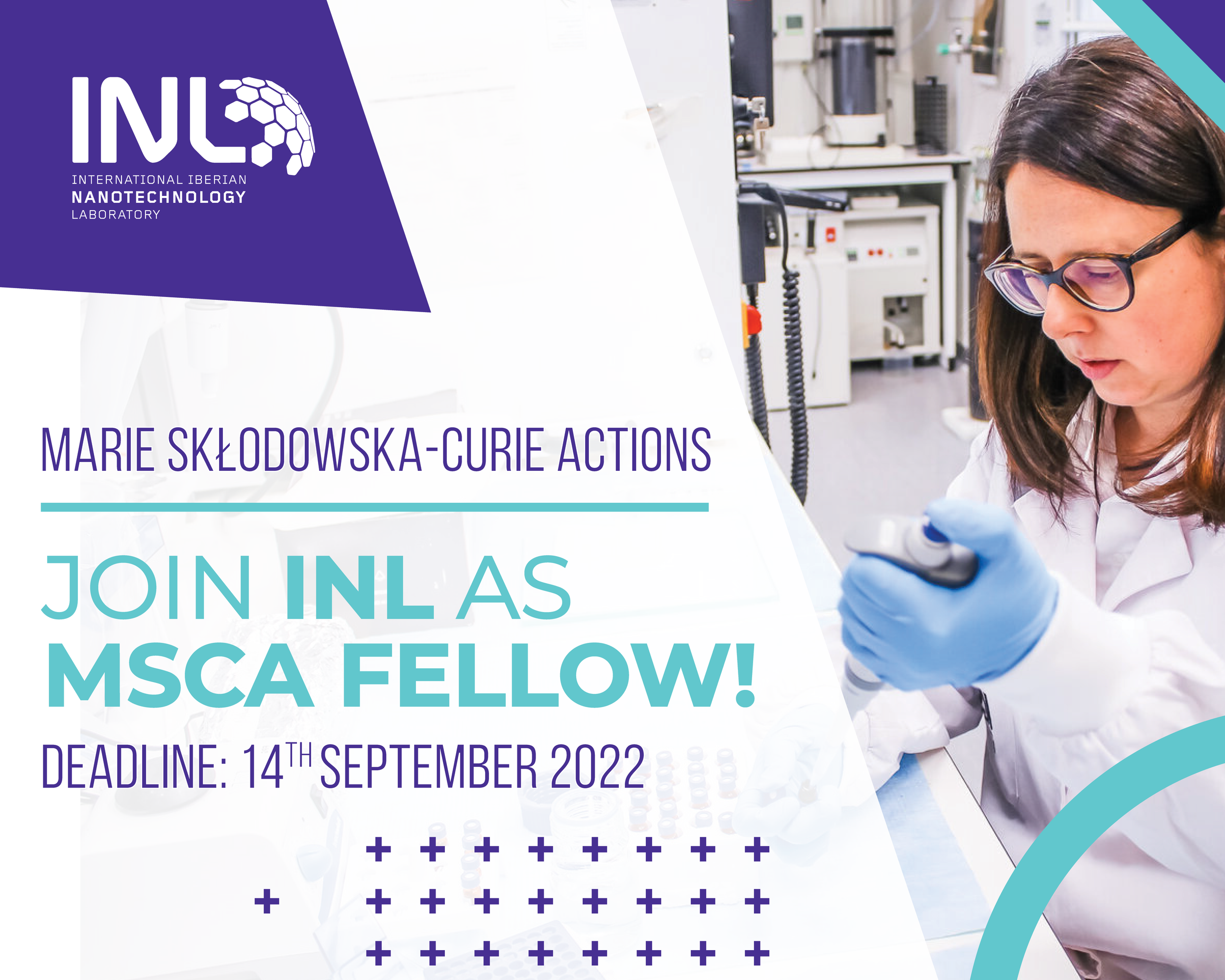

The INL- International Iberian Nanotechnology Laboratory is looking for talented researchers eager to work in our cutting-edge and inter-disciplinary organisation. The submission deadline to submit your application until September 14, 2022.

MSCA Individual Fellowship at INL gives researchers from all over the world unique career opportunities to:

The MSCA European Fellowship Grant Scheme

What?

Individual Fellowships (IF) provide funding to researchers of any nationality to acquire and transfer new knowledge and work on European research and innovation.

Who?

Candidates in possession of PhD at the call deadline. Up to 8 years of research experience after PhD (except for career breaks or work outside research). Mobility rule: not have spent at INL more than 12 in the 36 months.

Benefits?

The grant provides an allowance to cover living, travel and family costs.


KNOW MORE & Download the brochure here

Photonic Neuromorphic Computing session organized by ChipAI European project at AOP2022 International Conference


Photonic Neuromorphic Computing session organized by the European project ChipAI team at the 5th International Conference on Application of Optics and Photonics will take place July 18 to 22, 2022 at the Hotel de Guimarães Business & SPA, Guimarães, Portugal.

The ‘Photonic Neuromorphic Computing’ session covers key emergent areas such as materials for photonic computing, devices for photonic computing, photonic neural networks and deep learning methods, photonic accelerators, photonic reservoir computing, and brain-inspired photonic computing.

The session includes prestigious keynote/invited speakers and contributors working in the field, particularly within the frames of the EU H2020 and Horizon Europe projects such as PLASMONIAC, InsectNeuroNano, and ChipAI, to name a few. Young researchers and students will have the opportunity of exchanging knowledge and interact with academic and industry leaders by presenting their work. The speakers include:


LEARN MORE ABOUT THE CONFERENCE →

Bruno Romeira distinguished as Senior Member of Optica 2022 Class


Optica, Advancing Optics and Photonics Worldwide, announced this week the Senior Member class of 2022. A total of 170 Optica members have received the distinction of Senior Member, which recognizes their experience and professional accomplishment within the field of optics and photonics.

Bruno Romeira, Staff Researcher at the Ultrafast Bio- and Nanophotonics group and coordinator of the H2020-FET-OPEN project “ChipAI” was distinguished as a Senior Member of the 2022 class of Optica. His research cuts across several disciplines in applied physics and engineering, which include semiconductor physics, low-dimensional nanostructures and nanophotonic and neuromorphic devices.

“On behalf of the Board of Directors, I extend my congratulations to the new class of Optica Senior Members. These individuals have distinguished themselves through their exemplary professional accomplishments and service to Optica and the optics and photonics community,” said Optica President, Satoshi Kawata.

The 2022 class joins a distinguished group of scientists, engineers, entrepreneurs and innovators who have demonstrated exemplary professional accomplishments in optics and photonics. To qualify for Optica Senior Membership, individuals must have at least 10 years of significant professional experience in the field, five years of active Optica membership and two endorsement statements from current Optica members.

About Optica

Optica (formerly OSA), Advancing Optics and Photonics Worldwide, is the society dedicated to promoting the generation, application, archiving and dissemination of knowledge in the field. Founded in 1916, it is the leading organization for scientists, engineers, business professionals, students and others interested in the science of light. Optica’s renowned publications, meetings, online resources and in-person activities fuel discoveries, shape real-life applications and accelerate scientific, technical and educational achievement. Discover more at: Optica.org

Isabel Rodríguez among the best 5000 Spanish scientific women

Isabel Rodríguez, Research Fellow at the Food Processing and Nutrition Research Group, has been ranked among the best 5000 Spanish scientific women.

As part of CSIC’s institution’s commitment to gender equality policies, they’ve published the first edition of the Ranking of Spanish and foreign researchers working in Spain according to data from their personal public profiles on Google Scholar. This edition consists of the 5600 researchers ordered according to the highest h-index and secondarily by a number of citations.

“I am thrilled to be included in this list, which recognises the research I have been doing over the last ten years. It means that our research at INL is at the forefront of the food biotechnology sector and impacts the scientific community. Personally, it encourages me to do my best to achieve new developments that can impact society” says Dr Isabel Rodríguez Amado.

Dr Isabel Rodríguez Amado is a Biochemist and holds a PhD in Food Science and Technology from the Universidade de Vigo (Spain), and has postdoctoral experience at the University of Reading (UK) and at the Universidade do Minho (Portugal). Her research has covered disciplines from Food Biotechnology, Valorization and Food Processing, to Drug Delivery at different European institutions. She has over 30 peer-reviewed publications and was a co-author in 8 book chapters. She has also been involved in lecturing in Food Chemistry and Biochemistry disciplines, and in co-supervising postgraduate students in Spain, UK and Portugal.

She is a Research Fellow and works in the Food Processing and Nutrition research group. The research project she is involved in is focused on the development of new treatments for obesity by enhancing bioactive discovery-development and delivery to targeted tissues, through actuation on the microbiota-gut-brain axis.

Game-changing and disruptive technology as a biosensor researcher, an interview with Alejandro Garrido

Alejandro Garrido-Maestu joined INL – International Iberian Nanotechnology Laboratory in 2015 as a Marie Curie COFUND Research Fellow. Within this project, his research was aimed to develop a fast multipathogen detection lab-on-a-chip based on DNA amplification by loop-mediated isothermal amplification combined with gold nanoparticles.

Alejandro is now a Staff Researcher in the Food & Quality Research Group and his work is focused on the development, and application, of molecular methods for the detection and quantification of foodborne pathogens, the implementation of bacteriophages as fast detection tools, and discrimination among viable and dead microorganisms. To this end, he is working with different DNA amplification techniques such as PCR/ qPCR, LAMP, LCR and RPA.

Today, June 7, on World Food Safety Day, we aim to present our people and their work and at the same time draw attention and inspire action to help prevent, detect and manage foodborne risks, contributing to food security, human health, economic prosperity, agriculture, market access, tourism and sustainable development.


Can you tell us a bit about your path, your main area of work and the importance of your work?

I have a bachelor’s in biology a master’s in molecular biology and a PhD in microbiology and molecular biology. After my bachelor’s, I started to work as a microbiological analyst in a food testing laboratory and it was there when I started my research career working in the development of rapid methods for foodborne pathogen detection using real-time PCR. Upon completion of my PhD, I did a postdoc at the Emerging Pathogens Institute working on the synthesis of chitosan nanoparticles with antimicrobial activity. While there, I got a granted a Marie Curie COFUND fellowship to join INL to work on a similar topic to that of my PhD, rapid methods, but this time implementing isothermal nucleic acid amplification techniques as well as nanomaterials, this was in 2015 and since then, this has been my major focus.

Food testing is key to assuring the safety of consumers, thus reliable methods are always needed, and even though there are many available, in food microbiology, they tend to be lengthy, and you may need up to a week to reach a result. The type of work that I do at the FQS group at INL is devoted to reducing the time of analysis in this particular application, many producers cannot afford such delays in getting the results of an analysis in order to commercialize their products, without compromising the sensitivity or the specificity of the assays.

Dairy products have been implicated in foodborne infections and resistance to sanitation processes caused by different bacterial pathogens.


How the development of novel methods for rapid detection can change and help the current food and health burden of diseases and systemic illnesses?

The problem associated with this type of product is the fact that they tend to be prepared with raw milk, which has not undergone any kind of treatment to eliminate pathogens which may potentially be present. It is in this type of product that novel methodologies can make a difference. On the one hand, as just commented some of these products do not receive any kind of treatment they have short shelve lives thus it is of great importance to have the results as soon as possible in order to safely release the products. In addition to this, due to the sensitivity of these assays, they can be used for tracing contamination sources, not directly linked to the foodstuff itself, in the processing facilities. In the end, the combination of sensitivity, specificity and reduced turnaround time allows to assure the safety of the consumers and reduces the economic impact in the producers.


What inspires you and excites you about science?

I read somewhere something like “science is true whether you believe it or not”. So, it is based on facts and as such, it is a powerful tool to address the many different challenges that I face in my research and allows us to solve specific problems others may have.

As commented before, my background is the application of DNA-based methods to detect bacterial pathogens, but I can also use them for other purposes, up to now I have used my previous expertise for the identification of allergens, invasive species or even, very recently to detect SARS-CoV-2 in clinical samples.

And last but not least, any advice for students considering a career in science?

I always give the same piece of advice, if you want to do it go for it, and don’t let others stop you with things like “you’ll never find a job related to that” or similar comments, which I have personally heard several times.

It is true that it may be harder than other types of careers however, if you try hard you’ll make it. I have never been a brilliant student, but I loved what I was doing, after my bachelor it took me 6 months to get my first job related to “biology” and ever since this was 2006, I have never stopped working in science. I had to move to different places and countries (Barcelona, USA, Portugal…), and eventually even worked for free (for a short period of time), but I pushed for it and I believe I have succeeded. So, never stop!

Let’s all be inspired by Alejandro’s path, work and experience and let’s all work on improving food safety systems and chains. Because, food safety has a critical role in assuring that food stays safe at every stage of the food chain – from production to harvest, processing, storage, distribution, all the way to preparation and consumption. Remember, food safety is everyone’s business.

Next Page » « Previous Page -->

Alejandro Garrido-Maestu joined INL – International Iberian Nanotechnology Laboratory in 2015 as a Marie Curie COFUND Research Fellow. Within this project, his research was aimed to develop a fast multipathogen detection lab-on-a-chip based on DNA amplification by loop-mediated isothermal amplification combined with gold nanoparticles.

Alejandro is now a Staff Researcher in the Food & Quality Research Group and his work is focused on the development, and application, of molecular methods for the detection and quantification of foodborne pathogens, the implementation of bacteriophages as fast detection tools, and discrimination among viable and dead microorganisms. To this end, he is working with different DNA amplification techniques such as PCR/ qPCR, LAMP, LCR and RPA.

Today, June 7, on World Food Safety Day, we aim to present our people and their work and at the same time draw attention and inspire action to help prevent, detect and manage foodborne risks, contributing to food security, human health, economic prosperity, agriculture, market access, tourism and sustainable development.


Can you tell us a bit about your path, your main area of work and the importance of your work?

I have a bachelor’s in biology a master’s in molecular biology and a PhD in microbiology and molecular biology. After my bachelor’s, I started to work as a microbiological analyst in a food testing laboratory and it was there when I started my research career working in the development of rapid methods for foodborne pathogen detection using real-time PCR. Upon completion of my PhD, I did a postdoc at the Emerging Pathogens Institute working on the synthesis of chitosan nanoparticles with antimicrobial activity. While there, I got a granted a Marie Curie COFUND fellowship to join INL to work on a similar topic to that of my PhD, rapid methods, but this time implementing isothermal nucleic acid amplification techniques as well as nanomaterials, this was in 2015 and since then, this has been my major focus.

Food testing is key to assuring the safety of consumers, thus reliable methods are always needed, and even though there are many available, in food microbiology, they tend to be lengthy, and you may need up to a week to reach a result. The type of work that I do at the FQS group at INL is devoted to reducing the time of analysis in this particular application, many producers cannot afford such delays in getting the results of an analysis in order to commercialize their products, without compromising the sensitivity or the specificity of the assays.

Dairy products have been implicated in foodborne infections and resistance to sanitation processes caused by different bacterial pathogens.


How the development of novel methods for rapid detection can change and help the current food and health burden of diseases and systemic illnesses?

The problem associated with this type of product is the fact that they tend to be prepared with raw milk, which has not undergone any kind of treatment to eliminate pathogens which may potentially be present. It is in this type of product that novel methodologies can make a difference. On the one hand, as just commented some of these products do not receive any kind of treatment they have short shelve lives thus it is of great importance to have the results as soon as possible in order to safely release the products. In addition to this, due to the sensitivity of these assays, they can be used for tracing contamination sources, not directly linked to the foodstuff itself, in the processing facilities. In the end, the combination of sensitivity, specificity and reduced turnaround time allows to assure the safety of the consumers and reduces the economic impact in the producers.


What inspires you and excites you about science?

I read somewhere something like “science is true whether you believe it or not”. So, it is based on facts and as such, it is a powerful tool to address the many different challenges that I face in my research and allows us to solve specific problems others may have.

As commented before, my background is the application of DNA-based methods to detect bacterial pathogens, but I can also use them for other purposes, up to now I have used my previous expertise for the identification of allergens, invasive species or even, very recently to detect SARS-CoV-2 in clinical samples.

And last but not least, any advice for students considering a career in science?

I always give the same piece of advice, if you want to do it go for it, and don’t let others stop you with things like “you’ll never find a job related to that” or similar comments, which I have personally heard several times.

It is true that it may be harder than other types of careers however, if you try hard you’ll make it. I have never been a brilliant student, but I loved what I was doing, after my bachelor it took me 6 months to get my first job related to “biology” and ever since this was 2006, I have never stopped working in science. I had to move to different places and countries (Barcelona, USA, Portugal…), and eventually even worked for free (for a short period of time), but I pushed for it and I believe I have succeeded. So, never stop!

Let’s all be inspired by Alejandro’s path, work and experience and let’s all work on improving food safety systems and chains. Because, food safety has a critical role in assuring that food stays safe at every stage of the food chain – from production to harvest, processing, storage, distribution, all the way to preparation and consumption. Remember, food safety is everyone’s business.