Reading neurochemical signals with integrated graphene–CMOS
January 29, 2026
Understanding how the brain communicates chemically requires tools that can capture fast, subtle changes across many locations at once. Neurotransmitters such as dopamine, serotonin, or glutamate act on very short timescales and in highly localised regions of the brain, making their detection particularly challenging.
Graphene-based sensors have emerged as promising candidates for this task. Thanks to their atomic thickness and high sensitivity to ionic changes, graphene field-effect transistors (GFETs) can detect small variations in the chemical environment, making them well suited for neurochemical monitoring. Yet sensing is only half of the challenge. To fully exploit dense arrays of graphene sensors, compact electronic systems are needed to read many signals simultaneously, quickly, and reliably.
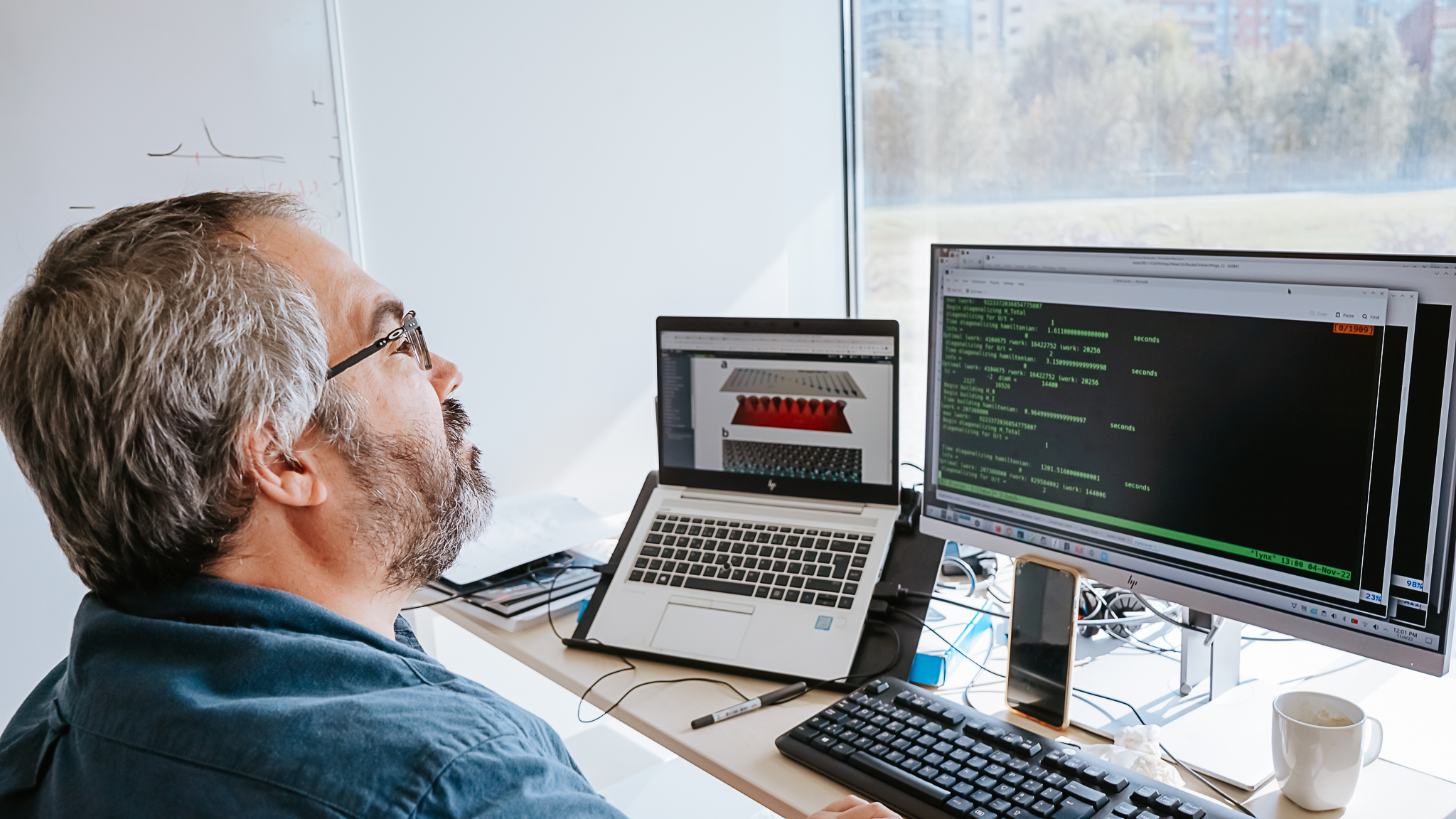
Researchers from the Piteira and Alpuim research groups at INL have now developed a CMOS-based electronic platform designed precisely for this purpose. Their work, published in IEEE Transactions on Circuits and Systems–I, presents an integrated system capable of reading signals from an array of 32 graphene transistors in real time, enabling detailed spatiotemporal mapping of neurochemical activity.
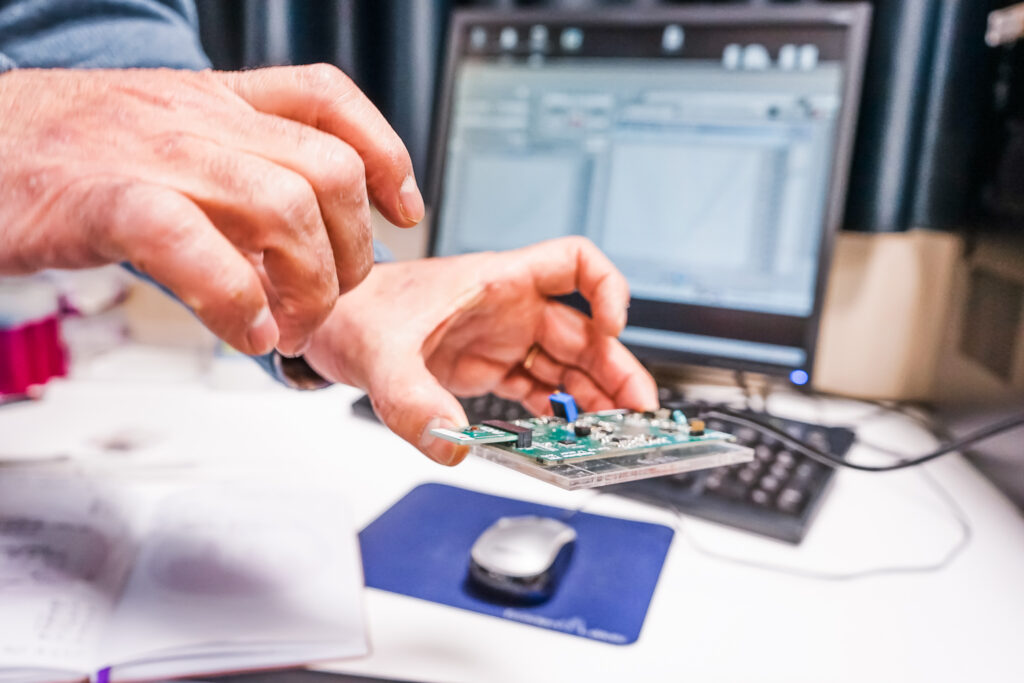
João Piteira, group leader at INL, explains “At the core of the platform is a custom-designed CMOS chip that converts tiny currents from graphene sensors into digital signals. By combining analogue front-end electronics with on-chip signal conversion and external programmable control, the system can monitor multiple graphene sensors simultaneously while maintaining a compact footprint and low power consumption.” This balance is essential for future brain-interface technologies, where size, energy efficiency, and scalability are critical constraints.
To test the platform under realistic conditions, the team worked with physiologically relevant solutions, including standard buffer solutions and dopamine dissolved in artificial cerebrospinal fluid. These experiments showed that the system can follow changes in graphene sensor signals as they happen, capturing both slow trends and fast fluctuations. “Designed with scalability in mind, the architecture can be extended to larger sensor arrays, bringing finer and more detailed chemical maps of brain activity within reach. Importantly, this work also lays the groundwork for future heterogeneous integration, where hundreds of graphene sensors could be directly combined with CMOS electronics,” adds INL group leader Pedro Alpuim.
Rodrigo Wrege, first author of this study, concludes that “By bringing together advanced graphene sensors and integrated CMOS electronics, our work shows how careful hardware design enables new possibilities in neurochemical sensing. Beyond systems-level integration, this platform addresses miniaturisation, sensor density, and power-efficiency optimisation — key requirements for future brain–machine interfaces and real-time chemical monitoring technologies.”
This research was funded by the “la Caixa” Foundation NeuralGrab project, FCT, the SMARTgNOSTICS Agenda, and COMPETE2030–FEDER.
See how we are sharing this breakthrough on LinkedIn, Facebook, Instagram & Bluesky!
Spotlight by Catarina Moura
Multimedia by Catarina Moura, Gina Palha and Rui Andrade
Social Media Campaign by Clara Miranda