How INL’s new research can turn windows into solar panels
May 27, 2026
Buildings account for a large share of global energy consumption, yet many of their surfaces, especially windows, remain unused for energy generation. Semi-transparent solar cells offer a way to change this, but existing approaches often come with trade-offs between efficiency, transparency, and visual quality.
Researchers at INL from Sadewasser group, in collaboration with partners at the University of Luxembourg and Zentrum für Sonnenenergie- und Wasserstoff-Forschung Baden-Württemberg (ZSW), are exploring a different path.
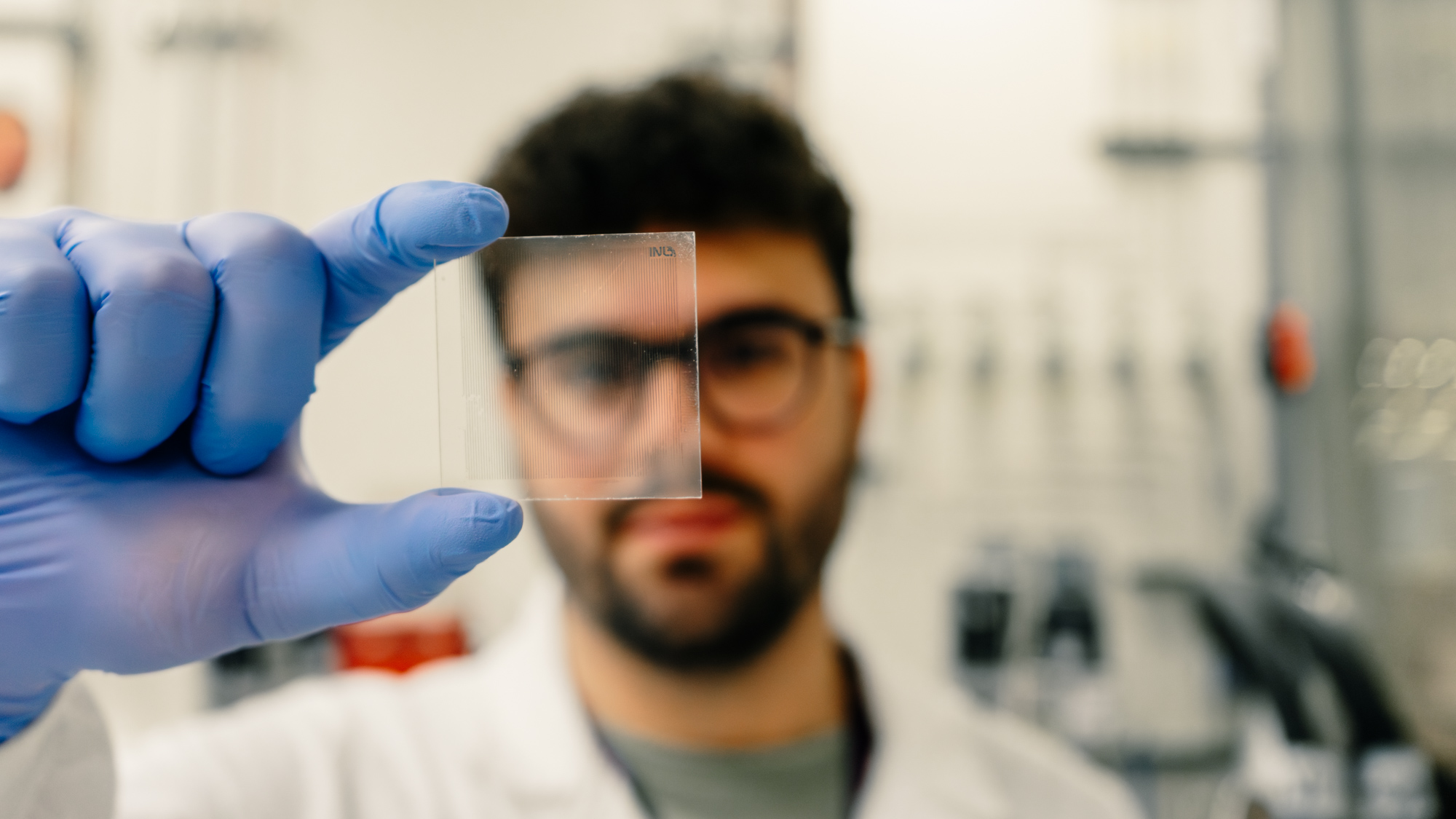
Instead of making solar cells thinner to let light pass through, which can reduce efficiency and change the colour of the transmitted light, the team developed an approach based on spatial segmentation. By patterning the solar cell into microscopic stripes separated by transparent regions, they can control how much light passes through while preserving the full thickness and performance of the active material.
When these micro-stripes are smaller than what the human eye can resolve, the window appears uniform and colour-neutral, maintaining visual comfort while generating electricity.
In a first study, the team demonstrated prototype micro-striped solar cells that provide high light transmission with excellent colour quality, maintaining a very high colour rendering index (CRI > 99),i.e colours appear as they would under natural sunlight. The results, presented in EES Solar, also indicate improved performance compared to conventional ultra-thin approaches at similar transparency levels, and highlight the potential of this concept across different operating conditions. Notably, record performance was demonstrated for semi-transparent Cu(In,Ga)Se₂ (CIGS) thin-film solar cells with a high level (>50%) of light transmission.
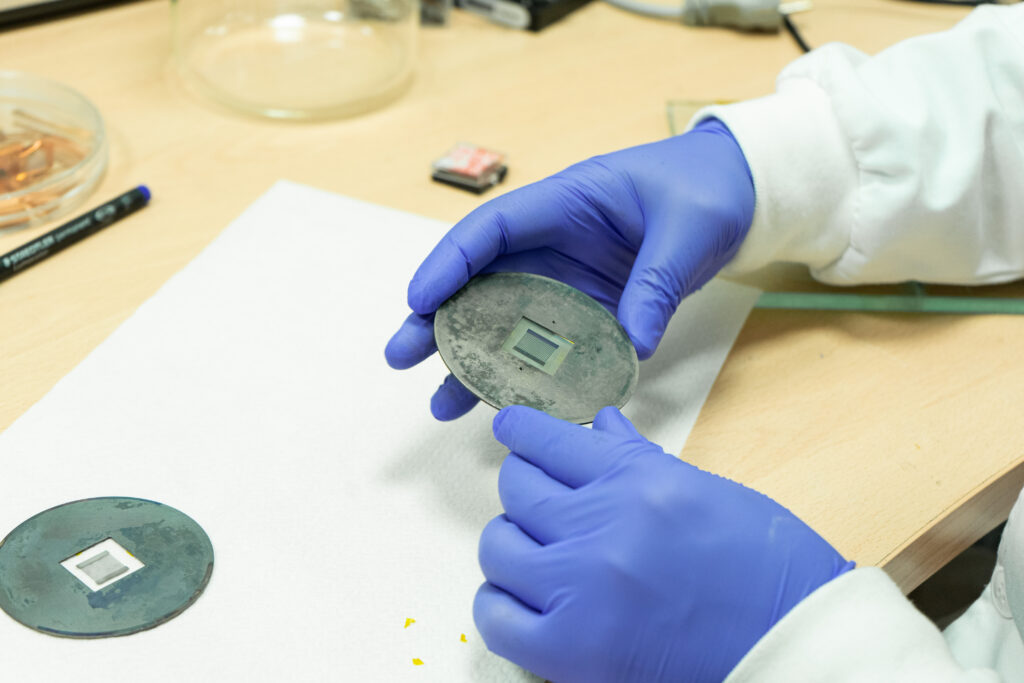
Building on this work, the researchers demonstrated that this concept can be implemented using scalable fabrication methods and extended to interconnected mini-modules. Published in RRL Solar, this work shows how these devices achieve a balance between transparency and performance, while also enabling efficient use and potential recovery of critical raw materials.
Overall, these studies led by Sascha Sadewasser point to a promising route for integrating photovoltaics into transparent surfaces, bringing us closer to buildings that can generate energy without compromising how they look or feel.
The research work presented was developed under the projects STAR-SOL (FCT – Fundação para a Ciência e a Tecnologia and Fonds National de la Recherche), Hi-BITS (European Union), and TRANSMIT (Co-funded by the European Union under the Clean Energy Transition Partnership and FCT).
Spotlight by Catarina Moura, Clara Miranda, and Rui Andrade
See how we are sharing this breakthrough on LinkedIn, Facebook, Instagram & Bluesky!