Seeing the invisible: How electron microscopy reveals the hidden structure of battery electrodes
January 9, 2026
Lithium-ion batteries power much of modern technology, yet their performance is still strongly shaped by something that remains difficult to observe: the internal structure of their electrodes. At the nano/microscopic scale, the arrangement of the active solid particles, carbon binders, and pores determines how electrons and ions move, how reactions unfold, and how efficiently a battery can operate.
Capturing this internal architecture in three dimensions is challenging. “Focused Ion Beam–Scanning Electron Microscopy (FIB-SEM) has been employed in tomography of battery electrodes, yet poor contrast between key electrode components has long limited reliable 3D reconstruction”, explains João Cunha, who led the study as a Marie Skłodowska-Curie fellow at INL.
INL researchers have now demonstrated a practical way to overcome this limitation. In a recent work, published in Energy Storage Materials, the team introduced an in-situ contrast-enhancement strategy that greatly improves the visibility of porous battery electrodes during FIB-SEM tomography.
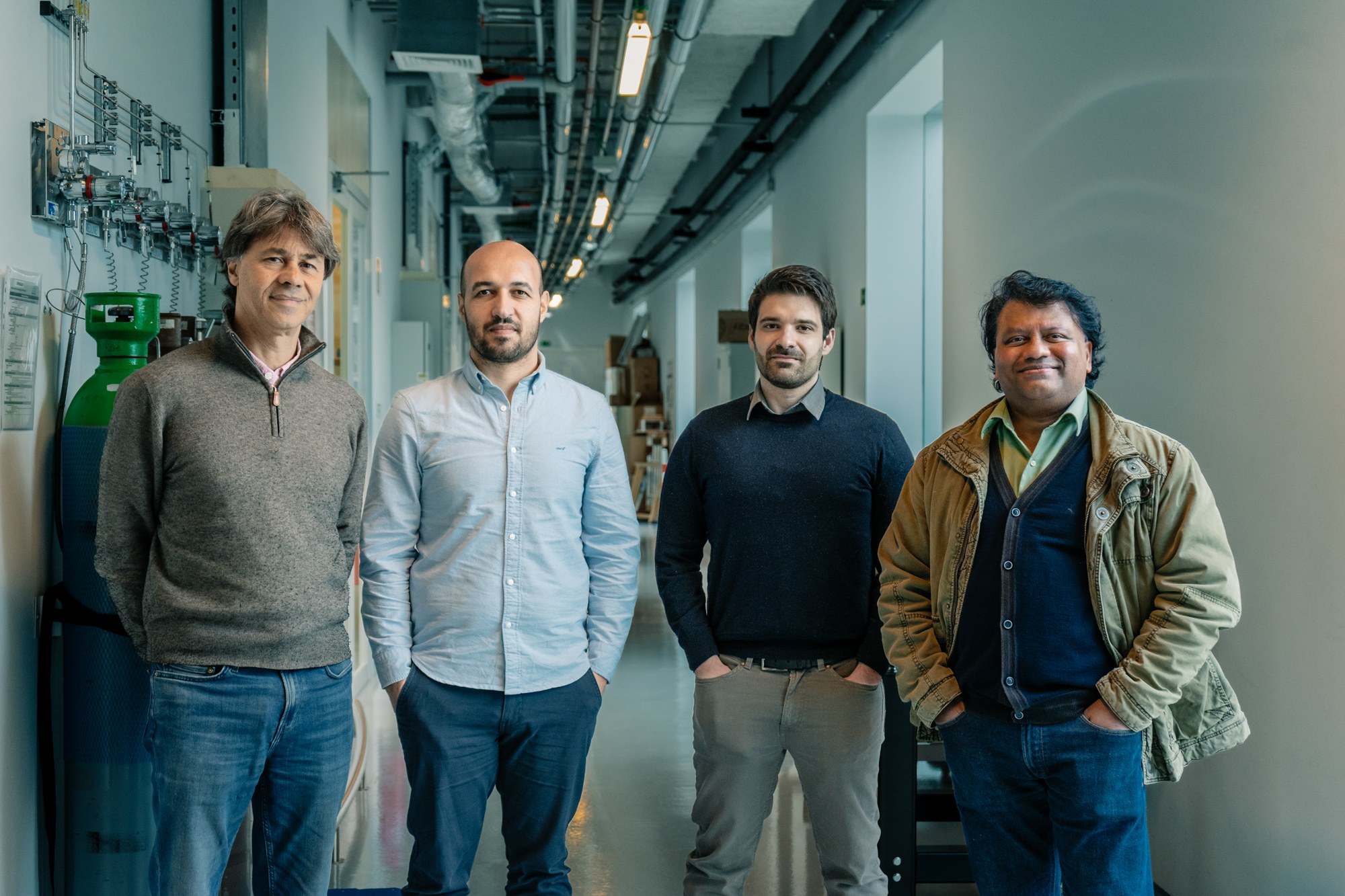
By enabling 3D observations into electrode microstructures, this work supports the development of better-informed models and design strategies for next-generation batteries. Developed by INL researchers João Cunha, Ihsan Çaha, Francis Leonard Deepak, and Paulo Ferreira, the study reflects INL’s focus on practical advances in energy storage characterisation.

“The approach enhances contrast directly inside a scanning electron microscope by filling the electrode’s pores with platinum using electron-beam–induced deposition”, adds João Cunha. This enabled contrast enhancement several micrometres deep into the electrode, allowing pores, carbon–binder regions, and active material particles to be clearly and reliably distinguished in three dimensions.
Research group leader Paulo Ferreira explains that “This improved contrast leads to more reliable 3D reconstructions and more confident quantification of microstructural features that directly influence battery performance. Importantly, the method can be implemented using standard dual-beam FIB-SEM systems, making it broadly accessible to battery researchers.”
Ihsan Çaha highlights the impact of the approach for quantitative analysis: “By reliably distinguishing pores from the carbon–binder domain, we can extract key microstructural parameters such as volume fractions, porosities and tortuosities with much higher confidence. This provides a stronger experimental basis for modelling battery operation processes and rationally guiding electrode design.”
The research study was carried out within the framework of the European Union’s Horizon Europe programme Marie Skłodowska-Curie Actions and the New Generation Storage (NGS) Innovation Pack.
Text by Catarina Moura, Science Communication Officer
Photography by Rui Andrade, Multimedia Officer