From April 19 to 21, INL – International Iberian Nanotechnology Laboratory had the honour to host the 2023 Annual INL Research Symposium. The event, an internal initiative, aimed at sharing and showcasing the research activities and accomplishments. The event also celebrates all our hard work and provides a forum for the breadth of activities being undertaken within each Research Group.
During the three half-days, we had more than 200 participants each day, 11 Research and Engineering Groups showcased 26 demos, excellent scientific presentations, more than 90 posters and video flash talks, and very engaging coffee breaks and ‘happy-hour’ moments. This was a unique internal event and a great occasion to learn and experiment new technological developments.
Next year, INL will continue promoting this event as part of the strategic plan for internal research dissemination activities and for creating an environment that encourages, stimulates and promotes research and researchers.
Thank you all for your brilliant hard work!
INL researchers develop a novel compact and low-cost microLED chip
Light-emitting diode chips, commonly known as LEDs, are semiconductor light sources that are used in smartphones for displays, automotive lighting, medical devices, sensors and optical communications. LEDs typically combine a large p-type doped semiconductor layer (layer with faulty conduction electrons; these lack of conduction electrons behave as positive charges called holes) with an n-type doped semiconductor layer (layer with abundant conduction electrons), forming a p-n junction. When a sufficient voltage is applied, electrons and holes move across the p-n junction and electrons recombine with holes releasing energy in the form of light.
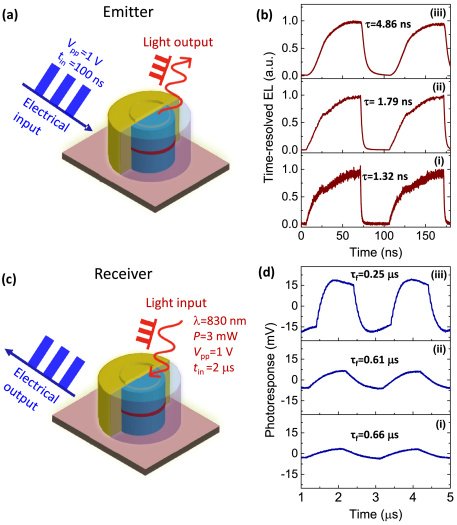
Temporal electrical and optical response of the microLED. (a) The emitter configuration for electro-optical modulation. (b) The time-resolved electroluminescence (EL) as a function of the forward bias voltage: (i) 2 V, (ii) 2.5 V, and (iii) 3 V for 1 V, 100 ns input electrical pulses. The determined decay lifetime (τ) is indicated for each bias condition. (c) The receiver configuration for optoelectrical modulation. (d) The photocurrent response to illumination by a laser source (𝜆∼830nm�∼830nm) driven by 1 V, 2 µs square-wave voltage pulses. The photocurrent was measured as a function of the forward bias voltage: (i) 2 V, (ii) 2.6 V, and (iii) 3.5 V. The photoresponse fall time (𝜏𝑓��) indicated for each bias condition is determined as the time between 10% and 90% of the maximum photocurrent.
The layered p-n junction structure is one of the most well-established semiconductor optoelectronic modern chip technologies that revolutionized the development of LEDs, lasers, and photodetectors. However, given the recent miniaturization of light-emitting and photo-detecting devices, such as nanoscale LEDs and nano-photodetectors, the use of p-type semiconductors adds significant complexity and associated costs to the device’s manufacture.
In this recent work, INL researchers in collaboration with the University of Lisbon, present a novel microLED chip that does not need p-type semiconductor layers. Furthermore, the developed microLED also has the astounding ability to work as both a light emitter and a detector, in the same circuit.
Bruno Romeira, the leader of this study, explains that “the architecture of the device provides a compact and low-cost microLED chip with seamless integration of multi-capabilities (electroluminescence, photoresponse and negative differential conductance – electrical on-chip gain), under identical operating forward voltage conditions”.
The findings of this study pave the way for a wide range of low-cost applications in on-chip light-emitting and light-receiver systems, of key importance for imaging, sensing, signal processing, data communications and neuromorphic computing AI applications.
This study was funded by the European Union, Horizon Europe, under project 828841 – ChipAI, and project 101046790 – InsectNeuroNano. You can find the full article here: https://doi.org/10.1364/OPTICA.476938.
Meet Elvira Paz, Staff Researcher in the Spintronics Research Group
Today you can meet Elvira Paz. Elvira is Staff Researcher in the Spintronics Research Group at INL – International Iberian Nanotechnology Laboratory. She obtained an MSc (2004) and a PhD (2010) in Physics from the Universidad Autónoma de Madrid | UAM . Her current research focuses on magnetic sensors based on MTJs.
During her PhD, she focused on the growth of epitaxial iron and its structural and magnetic characterization, and afterwards, she performed the lithography of wire and antidot nanostructures to study their magnetic behaviour. She studied the influence of the iron’s magnetic biaxial anisotropy on the nanostructures’ magnetic properties, the combination of the crystalline and the shape anisotropies.
Her research is focused on fabricating and characterising magnetic sensors based on magnetic tunnel junctions. Her main objective is to decrease the sensitivity of the sensors as much as possible to achieve a very accurate measurement of low fields. This allows using sensors in a wider range of applications. During her work at INL – International Iberian Nanotechnology Laboratory she published more than 20 international papers, and two patents application and presented her work at several international conferences.

At INL since 2011, can you tell us a bit about your journey?
I joined INL – International Iberian Nanotechnology Laboratory in March 2011. This has been a long 12 years journey, and during all this time I had evolved professionally and personally. I had the luxury to work in a laboratory with state-of-the-art equipment that gave me the opportunity to study systems that are in our daily lives to try to improve the lives of people. Improving people’s well-being motivates me to keep going. And at the same time being surrounded by international colleges make you travel while working when we talk about different cultures.
How would you explain the importance of your work to a non-scientific person?
My research is focused on magnetic sensors. Magnetic sensors are present in everything that we have around us, from our mobile phones to our home appliances, and lately, there is a lot of research for the car industry to improve autonomous driving.
Recent trends in magnetic sensors are focused on miniaturization, the improvement of features and finding new operating principles based on fundamental studies of new materials and phenomena. Making better sensors and more efficient in terms of energy is a challenge that will be good for us and for the planet and future generations.

How do you feel the landscape will change for women in science over the next 5 years?
I think the landscape is changing, but it is changing faster in the biology area than the physics and electronics, and I don’t see a lot of young women in this area. I think we’ll need a lot more than 5 years to see a change. Diversity and collaboration are two things the scientific community lacks, and both are related to the poor experiences women have in physics.
The only way to have a change is to start to make the girls feel inspired by physics at smaller ages. There are a lot of studies that saw that the environment shapes girls’ interest and motivation in STEM and that female role-model sessions significantly increase the positive impact of expectations of success on STEM choices. We have to work hard on that to see a change in the landscape.
Mission NERD visits Braga Hospital
Mission NERD is, once again, out of the laboratory. Researchers from INL – International Iberian Nanotechnology Laboratory visited the Pediatrics Service and the External Consultation Services of Hospital de Braga and the purpose of this visit was to showcase the world of science and the work developed by our Researchers.
Visitors and family members were able to experience various activities, such as drilling a balloon without popping it, making the hair stay standing, measuring the height in nanometers or even dressing like a nanoscientist. Humanizing knowledge, facilitating the understanding of science, and decoding some concepts of science through simple activities using everyday materials were the main goals of this visit.
Mission NERD aims to decode science to society in a whole new way, create unique experiences, stimulate creativity, enable dialogue and spread scientific knowledge to the community. Our volunteers are committed scientists working at INL – International Iberian Nanotechnology Laboratory that wants to inspire and re-connect people of different realities by using a common ground – the spirit of sharing.
INL researchers are actively working on battery technology towards Clean Energy
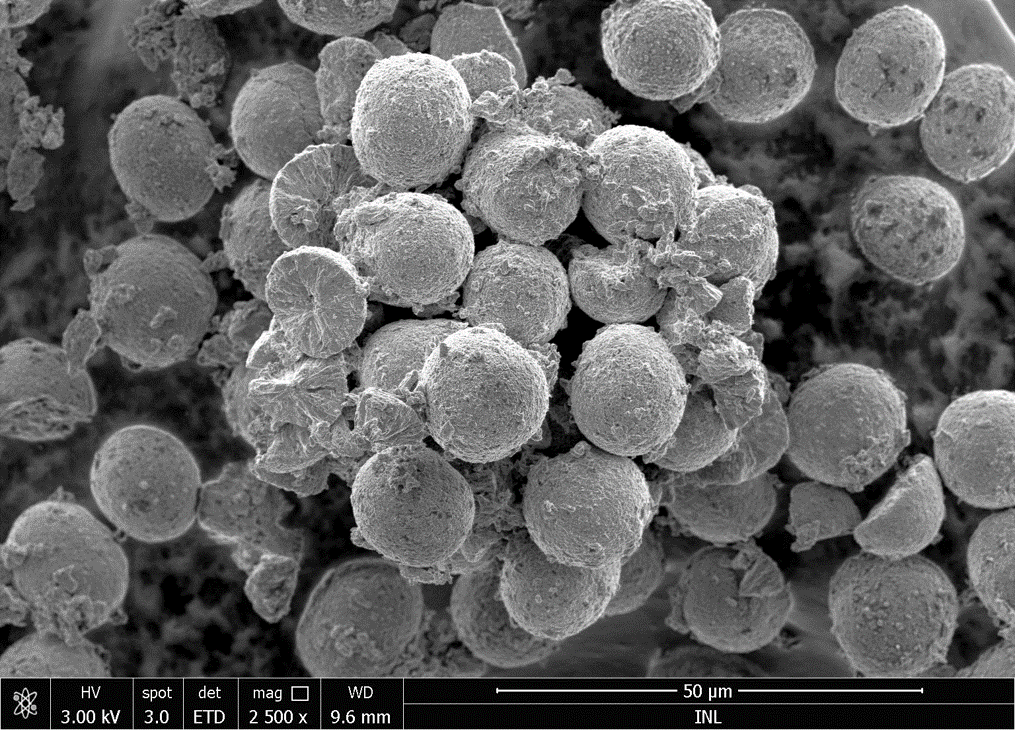
This image was taken by the researcher Cristiana Alves, Arumugam Manthiram and Paulo Ferreira using a scanning electron microscope. It shows micro-sized particles of elements found in lithium-ion batteries used in electric vehicles (lithium, nickel, manganese, cobalt and oxygen).
The most used energy sources today are based on resources that will not be naturally renewed at the pace at which these are currently being consumed. There is an urgent need to develop new materials and technologies that will enable society to convert to renewable energy sources.
One must consider that renewable sources can only produce electricity based on the resources availability – sun, wind, water, waste, and heat from the Earth; consequently, by default, renewable sources might not be available according to consumption, which might create grid issues when deployed in large scale. With the increasing use of renewable energy, there is a need to increase energy storage, such as batteries.
INL researchers from the Clean Energy cluster are actively researching battery technology.
Here is a highlight of the ongoing projects:
INL is developing anode materials with carbon and silicon (Si/C) composites with enhanced storage capacity and cycling stability.
-
HEDAsupercap (Horizon Europe)
The aim of this European-funded project is to fabricate supercapacitor cells with an energy density 8 times higher than the state-of-the-art EDLC supercapacitors in the market and demonstrate their use in hand-warming gloves and e-scooters.
Within the NGS Agenda funded by Portugal’s recovery and resilience plan (PRR), INL is participating in several research activities in all of the battery value chain, creating a new battery ecosystem such as the production of battery components and the development of new materials and processes for battery fabrication.
For more detailed information, please follow the project links. These projects are all highly collaborative, both with academia and industry, at different stages and technology readiness levels (TRL).
World Health Day: INL scientists are exploring new technologies towards #HealthForAll
Today, April 7th, we celebrate World Health Day.
INL scientists are exploring new technologies combining both the biological understanding of diagnostics and therapeutics with engineering expertise in sensors, microfluidics, electronics, photonics and microscopy. Today we share with you a few projects we are currently working on at INL.
Lorena Diéguez, group leader of the Medical Devices research group, is working on the project PROMISE, funded by “La Caixa” Foundation, to develop an innovative platform to mimic the tumoural microenvironment of patients with metastatic colorectal cancer using bioprinted hydrogel microfluidics. Lorena explains that ‘this research will allow a better understanding of the metastatic process and ultimately enable the design of new therapeutic approaches’.
A few labs down the corridor, we can find the Nanosafety research group working on the European project LEARN, together with other researchers at INL. The overall goal of this project is to develop and set up novel sensors to detect the presence of harmful air pollutants in schools. The researcher Ana Ribeiro adds, “We will evaluate the effect of air pollutants in children’s cognition and how correcting the air quality has a positive impact”.
Jérôme Borme, a researcher in the team 2D Materials and Devices, is currently working on a project included in the SMARTgNOSTICS agenda funded by the Portuguese Recovery and Resilience Plan (PRR), developing miniaturised devices that will monitor the presence of antibiotics residues in the environment, and detect the presence of multidrug-resistant bacteria.
Another project INL researchers are working on is LifeSaver, funded by the European Union. Andrea Cruz, from the Nanodevices group, explains that ‘we are developing integrated systems to screen chemicals and pharmaceuticals that might affect pregnant women’s health. At the same time, we want to reduce animal, preclinical and clinical testing, which is impossible with other existing approaches to the same confidence level.’
Elisabete Fernandes, also working in the Nanodevices team, is leading the project FIM4Stroke. She is currently developing a point-of-care diagnostic system to integrate conventional stroke management, acting as an auxiliary tool when examining intravenous.
This year’s World Health Day celebration motto is Health for All. This is an opportunity to look back at public health successes that have improved quality of life and to motivate action to tackle the health challenges of today and tomorrow.
Today, April 7th, we celebrate World Health Day.
INL scientists are exploring new technologies combining both the biological understanding of diagnostics and therapeutics with engineering expertise in sensors, microfluidics, electronics, photonics and microscopy. Today we share with you a few projects we are currently working on at INL.
Lorena Diéguez, group leader of the Medical Devices research group, is working on the project PROMISE, funded by “La Caixa” Foundation, to develop an innovative platform to mimic the tumoural microenvironment of patients with metastatic colorectal cancer using bioprinted hydrogel microfluidics. Lorena explains that ‘this research will allow a better understanding of the metastatic process and ultimately enable the design of new therapeutic approaches’.
A few labs down the corridor, we can find the Nanosafety research group working on the European project LEARN, together with other researchers at INL. The overall goal of this project is to develop and set up novel sensors to detect the presence of harmful air pollutants in schools. The researcher Ana Ribeiro adds, “We will evaluate the effect of air pollutants in children’s cognition and how correcting the air quality has a positive impact”.
Jérôme Borme, a researcher in the team 2D Materials and Devices, is currently working on a project included in the SMARTgNOSTICS agenda funded by the Portuguese Recovery and Resilience Plan (PRR), developing miniaturised devices that will monitor the presence of antibiotics residues in the environment, and detect the presence of multidrug-resistant bacteria.
Another project INL researchers are working on is LifeSaver, funded by the European Union. Andrea Cruz, from the Nanodevices group, explains that ‘we are developing integrated systems to screen chemicals and pharmaceuticals that might affect pregnant women’s health. At the same time, we want to reduce animal, preclinical and clinical testing, which is impossible with other existing approaches to the same confidence level.’
Elisabete Fernandes, also working in the Nanodevices team, is leading the project FIM4Stroke. She is currently developing a point-of-care diagnostic system to integrate conventional stroke management, acting as an auxiliary tool when examining intravenous.
This year’s World Health Day celebration motto is Health for All. This is an opportunity to look back at public health successes that have improved quality of life and to motivate action to tackle the health challenges of today and tomorrow.